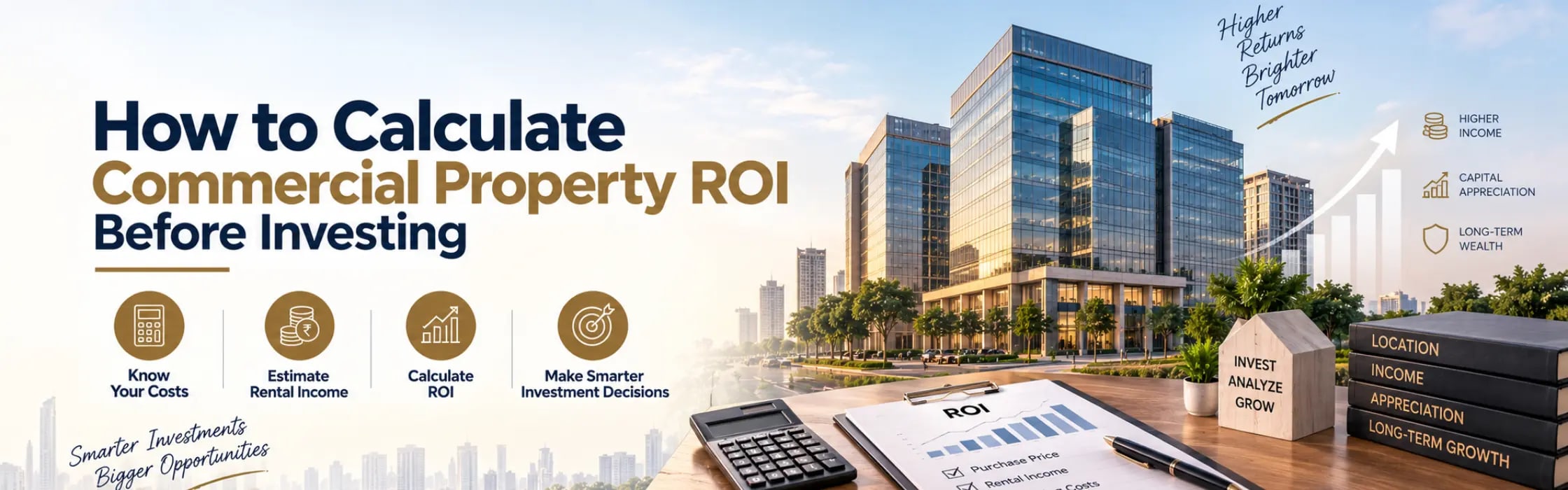
How to Calculate Commercial Property ROI Before Investing
Getting high returns on any investment we make, especially a commercial property investment, proves every penny was worth spending. However, when one makes a commercial property investment, they do study various factors apart from the total purchase price, and they calculate ROI before investing. The calculation of return on investment (ROI) can be useful for investors to gauge the income that they can generate from their investment compared to the total investment. So, it's essential to calculate property ROI before investing, whether you’re buying a home, a rental property, or commercial space. This blog will discuss the process of calculating ROI and how it is beneficial when making any commercial property investment.
What is ROI in Commercial Property
Commercial property ROI (Return on Investment) measures the return generated by a commercial property relative to the investment or costs considered in the calculation. Depending on the method used, ROI may include rental income, operating expenses, financing costs and changes in the property's value.
Investors can use ROI to compare potential properties, assess profitability and understand whether an investment aligns with their financial objectives.
Why Does Commercial Property ROI Matter?
Commercial property ROI is significant to:
- To check the underperformance asset in order to avoid overpaying while making commercial real estate investments.
- To compare different commercial property returns while studying various commercial properties.
- To forecast long-term profitability
- To avoid bad investments based on the appearance of the properties with poor returns.
- It helps to align property with financial goals.
Factors Affecting Commercial Property ROI
1. Location
Location, when making a commercial real estate investment, influences tenant demand, rental rates, vacancy risks, and long-term property appreciation. Properties near major highways, public transit hubs, airports, and major arterial roads attract stable businesses and command higher rental values.
Making commercial property investments in high-demand areas results in higher rent and appreciation.
2. Financing Cost
If a commercial property is purchased using debt, interest rates, loan tenure, processing fees and repayment obligations can affect the investor's cash flow and overall return.
A property may appear attractive based on rental income alone, but financing costs can reduce the amount of cash available to the investor. Therefore, investors should calculate returns both before and after financing costs where applicable.
3. The Cost of Maintenance and Property Taxes
Operating expenses like maintenance, property taxes, and society charges are like the silent killers of commercial property returns. To upkeep an older property requires much higher maintenance costs, leading to big repair shocks, unhappy tenants and higher electricity bills. Also, commercial property taxes are much higher than residential taxes, including high monthly fees for security, parking, and cleaning common areas. Hence, these factors significantly affect commercial property returns when making a commercial real estate investment.
4. Vacancy Rates
High vacancy rates directly reduce your annual rental income because empty properties generate zero cash flow while fixed expenses (like mortgages, taxes, and insurance) remain constant. Hence, before commercial property investment, evaluating the local rental demand to ensure consistent tenancy is extremely crucial.
5. Property Type
Residential real estate (like houses or apartments) offers lower property returns, making it easier to find tenants, whereas commercial real estate pays higher commercial property returns, but it is riskier because finding a new business tenant can take a very long time if the economy slows down.
How to Calculate Commercial Property ROI
A simple ROI calculation can help investors estimate the potential annual return from rental income and property appreciation. However, investors should distinguish between rental yield, cash flow, and total investment return, as each measures a different aspect of property performance.
Basic Commercial Property ROI Formula
ROI (%) = [(Annual Rental Income − Annual Operating Expenses + Annual Property Appreciation) ÷ Initial Investment] × 100
This simplified calculation assumes that the appreciation amount represents the property's increase in value over the period being evaluated.
Example
Suppose you are considering a commercial property with:
- Property Price: ₹60,00,000
- Annual Rental Income: ₹4,20,000
- Annual Operating Expenses: ₹60,000
- Assumed Annual Appreciation: 5%
- Annual Appreciation Amount: ₹3,00,000
First, calculate the net rental income:
₹4,20,000 − ₹60,000 = ₹3,60,000
Then add the assumed annual appreciation:
₹3,60,000 + ₹3,00,000 = ₹6,60,000
Now calculate the simplified annual ROI:
₹6,60,000 ÷ ₹60,00,000 × 100 = 11%
Therefore, the property's simplified annual total return is 11%, based on the assumptions above.
Important: This is an illustrative calculation, not a guaranteed return. Actual returns can differ because of vacancy, taxes, transaction costs, financing costs, changes in rent, maintenance expenses and changes in property value.
Commercial Property ROI vs Rental Yield
Rental yield and ROI are related but they are not the same measure.
Rental yield focuses primarily on the rental income generated by a property relative to its cost, while ROI can incorporate other factors such as operating expenses, financing costs and changes in property value.
A simple gross rental yield can be calculated as:
Gross Rental Yield (%) = (Annual Rental Income ÷ Property Cost) × 100
For example, if a ₹60 lakh property generates ₹4.2 lakh in annual rent:
₹4,20,000 ÷ ₹60,00,000 × 100 = 7% gross rental yield
The investor can then consider operating expenses, vacancy and other costs to estimate the property's net return.
What Should Be Included in Total Investment Cost?
When calculating commercial property ROI, investors should look beyond the property's purchase price. Depending on the transaction, the total investment may include:
- Property purchase price
- Stamp duty and registration charges
- Applicable taxes
- Brokerage
- Legal and documentation fees
- Renovation or fit-out costs
- Loan processing and financing costs
- Initial maintenance or setup expenses
Including relevant acquisition and operating costs can provide a more realistic picture of the investment's potential return.
Common Commercial Property ROI Calculation Mistakes
- Ignoring acquisition costs: Include applicable stamp duty, registration, brokerage, legal fees and taxes.
- Using gross rent as net income: Account for relevant operating and maintenance expenses.
- Ignoring vacancy: Consider potential periods without tenants.
- Overestimating rent: Compare expected rent with current market rates for similar properties.
- Assuming appreciation: Treat future appreciation as an assumption rather than a guaranteed return.
- Ignoring financing costs: Include interest and other borrowing costs when evaluating a financed investment.
- Using only one return metric: Compare rental yield, cash flow and overall ROI to get a broader picture.
What to Check Before Investing in Commercial Property
ROI is only one part of a commercial property investment decision. Investors should also evaluate the property, local market, tenant demand and total ownership costs before committing capital.
- Study local market demand
- Compare rental rates and potential rental yield
- Calculate total acquisition and ownership costs
- Assess vacancy and tenant risks
- Review the property's physical condition
- Evaluate location and connectivity
- Consider potential appreciation
- Check relevant property documents and approvals
Also Read: Residential vs Commercial Property Investment: Which One Should You Choose?
Conclusion
Commercial property investment decisions should be based on more than the purchase price or expected rent. Calculating potential ROI, rental yield, operating expenses, vacancy risk, financing costs and property appreciation can help investors understand the possible return before committing capital.
However, ROI calculations are based on assumptions and should not be treated as guaranteed returns. Investors should also review the property's documents, market demand, tenant profile, condition and total transaction costs before making a decision.
For real estate businesses managing property enquiries and sales alongside investment activities, Big Estate Enterprise provides CRM, AI calling, WhatsApp automation and campaign management capabilities to help teams organise and manage their sales processes more efficiently.