How CRM Software Helps Businesses Manage Leads Effectively
Most businesses lose leads because nobody followed up in time, the note was saved in the wrong place, or two representatives contacted the same person while a third never got touched. CRM software for lead management exists specifically to fix those problems. This blog guides how CRM software for lead management handles leads at every stage, what to look for in a system, and how it changes the day-to-day reality of a sales team.
What Is CRM Software Managing Leads?
CRM software for lead management is a platform that stores and organises every interaction between a business and its potential customers from the moment someone first shows interest to the point where they either buy or drop off.
It's different from a basic contact list or spreadsheet. A CRM tells you who your leads are, where they came from, and what should happen next. Think of it like a sales representative who manages 50 leads in their head will drop a few every week. A sales representative who manages 50 leads inside a CRM with automated reminders and follow-up sequences will drop very few, if any.
How Does a Sales CRM Handle Leads?
The best way to understand this is to follow a lead through the system from start to finish.
1. Lead Capture
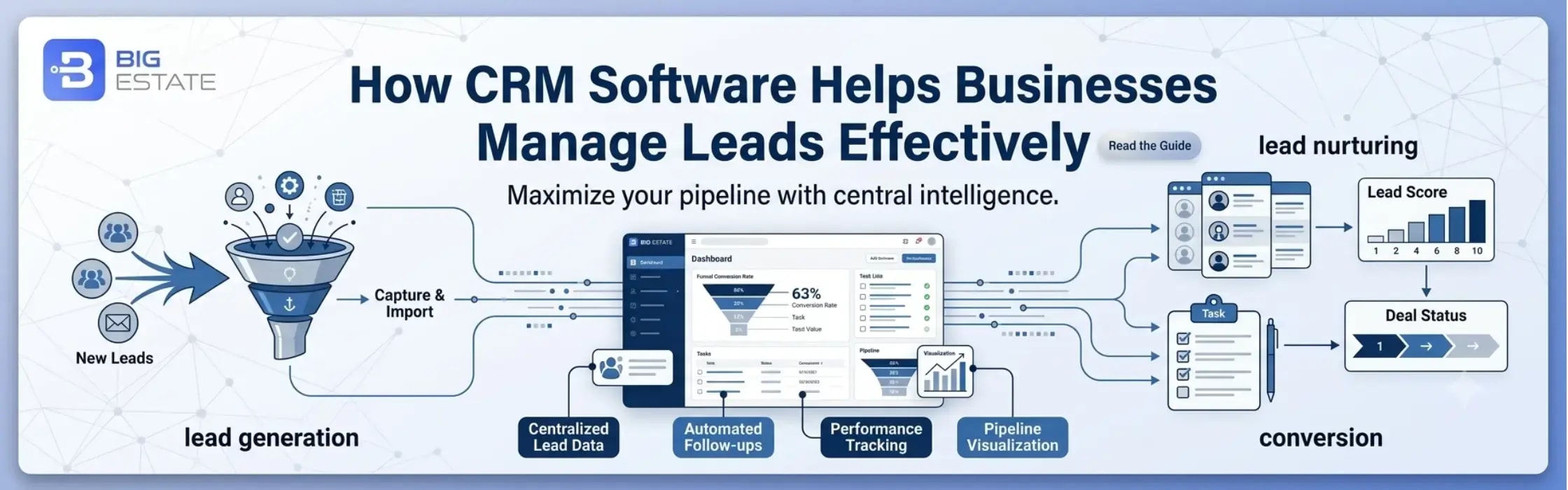
Leads enter the CRM automatically from whatever source generated them, from a website form, a Facebook ad, a property portal, a phone call, etc. In a well-to-do system, the rep doesn't need to manually create a lead record. It's already there by the time they look.
2. Lead Tracking Through the Pipeline
Once assigned, the lead moves through a pipeline, which is a visual representation of where every prospect sits in the sales process. Instead of asking each rep "Where are we with that client from last Tuesday," a manager can look at the pipeline and immediately see how many leads are at each stage, which ones have been sitting in the same stage for too long, or which reps have too few or too many active leads.
3. Follow-Up Sequences
The CRM automates the follow-up with call reminders, WhatsApp messages, email sequences, and site visit confirmations. In real estate, this is where most deals are lost without a CRM because follow-up stops after the first or second attempt.
4. Handoff and Closure
When a lead is ready to move to a booking, the CRM records the handoff. Everything the sales representative knows about that buyer, from their budget to the questions they asked during a site visit, gets visible to whoever handles the next step.
Key Features to Look for in Customer Relationship Management Software
The features that actually matter, depending on the type of business, are as follows:
- Auto capture of leads
- Pipeline view
- Automated follow-up
- Lead scoring (ranks leads by how they're behaving)
- Conversation logging
- Mobile access (check lead status from their phone in real time)
- CRM integrations
The Difference Between a Generic CRM and a Sector-Specific One
Most popular CRMs like Salesforce, HubSpot, and Zoho are built for general business use and adapted for specific industries over time. They work well, but they require significant customisation.
A sector-specific CRM is built from the ground up for the way that the industry actually operates. In real estate, for example, that means tracking leads by project, managing channel partners separately, supporting RERA compliance, and integrating natively with portals like MagicBricks, 99acres, and Housing.com. A generic CRM can do some of these things with enough configuration work. A purpose-built one does them out of the box.
Common Challenges CRM Software Solves in Lead Management: Best Practices When Implementing a CRM
- Define your pipeline stages before you configure anything: Stages like "in progress" tell you nothing. Use stages that reflect actual decisions: enquiry received, site visit booked, site visit done, proposal sent, booking.
- Make lead capture automatic: If reps have to manually add leads, some will be missed. Every source, like portals, web forms, and ad leads, should flow in without manual input.
- Set follow-up rules at the system level: If follow-up depends on a rep remembering, it won't happen consistently.
- Log every conversation: WhatsApp messages, site visit notes, and email threads belong inside the CRM, not in personal accounts.
- Review the pipeline weekly: Leads go cold in days. Weekly reviews catch stalling deals while there's still time to act.
- Track cost per closing, not just cost per lead: A source that sends 100 leads producing zero closings is worse than one that sends 20 and closes five.
Conclusion
Most CRM software for lead management platforms was designed for general use and adapted for industries like real estate later. Big Estate’s CRM was built the other way around, starting with the specific realities of Indian real estate sales and designing the system to match.
That means portal auto-import from MagicBricks, 99acres, and Housing.com on day one with no third-party connectors. WhatsApp is integrated as the primary communication channel, with every conversation saved inside the sales CRM. Multi-project pipeline management where each project tracks its own leads, its own CPL, and its own conversion data independently. And a 60-second response trigger that ensures every new enquiry gets an AI-assisted call or WhatsApp message.
For Indian real estate developers managing scale like multiple projects, high portal lead volumes, and large sales teams, Big Estate is the only customer relationship management software purpose-built for this specific workflow.
Also Read: Top Lead Generation Strategies for Real Estate Businesses