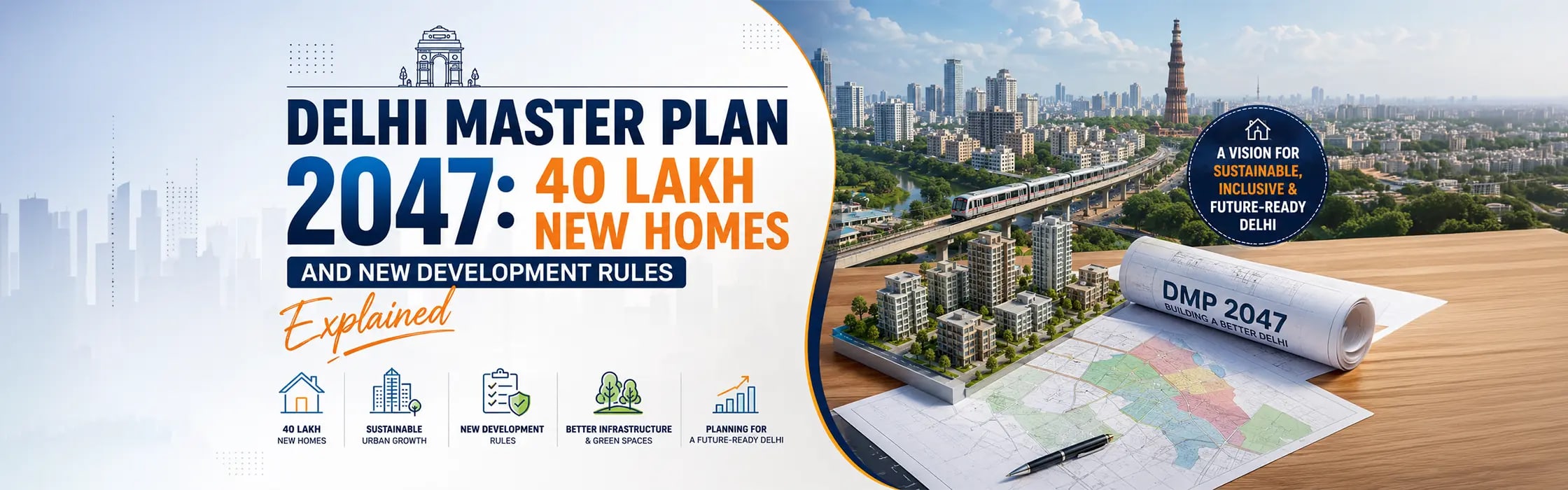
Delhi Master Plan 2047: 40 Lakh New Homes and New Development Rules Explained
Delhi has been waiting for a new master plan for years. What was originally meant to be MPD-2041 got delayed and was eventually replaced altogether. Now it has a name: the Delhi Master Plan 2047, notified as MPD-2047 and it sets out one of the most ambitious housing and infrastructure plans the capital has seen in decades. This blog shows what the plan actually says, what changes for homeowners and buyers and why it matters if you're tracking the Delhi property market.
What Is the Delhi Master Plan 2047?
MPD-2047 was notified by the Union government as a long-term plan that covers housing, transport, infrastructure, economic development, as well as environmental sustainability, with Delhi's population projected to reach around 3.2 crore by 2047. It was approved by the Delhi Development Authority and cleared by the Lieutenant Governor on August 12, replacing the long-delayed MPD-2041. The plan has since received formal Gazette notification from the Centre, giving MPD-2047 legal and administrative status.
The plan is built around two distinct planning approaches: area-based redevelopment for already built (brownfield) areas and Right of Way-based planning for undeveloped (greenfield) land. That matters because it shapes how old colonies get redeveloped versus how new land gets opened up.
40 Lakh Homes Under Delhi Master Plan 2047 Housing
The plan estimates a requirement of 40 lakh additional homes that include affordable housing to accommodate Delhi's projected population growth. That works out to roughly four million additional homes needed as the city's population grows from around 23 million currently to a projected 32 million by 2047.
Here's how that housing target is shown by the planning approach:
| Development Type | Details |
|---|---|
| Land pooling (greenfield) | Around 200 sq km earmarked, expected to deliver approximately 12 lakh homes alongside a 695 km road network. |
| Redevelopment (brownfield) | Covers group housing, DDA housing and government housing colonies, many over 50 years old. |
| Low Density Areas | Nearly 150 sq km covering peripheral villages and 23 notified low-density residential area villages. |
The plan also renews the "Jahan Jhuggi, Wahan Makan" (Housing-in-Situ) scheme that also prioritises permanent housing for low-income families directly within their existing locations.
New Redevelopment Rules For Old DDA Colonies
A uniform redevelopment framework has been approved for old two-storey DDA housing units built on individual plots, many of which date back more than 50 years to the original 1962 master plan. Under this new approach, built-up plots can receive redevelopment rights similar to vacant residential plots, subject to norms covering FAR, ground coverage, height, fire safety and structural safety. This means older colonies could see more housing built on the same footprint without the city needing to expand outward. Resident welfare associations are also encouraged to register and adopt a redevelopment framework similar to the in situ redevelopment policy.
Also Read: DDA Housing Scheme 2026: Eligibility, Prices And How to Apply
Delhi Master Plan 2047 FAR Rules
Floor Area Ratio (FAR) is one of the most closely watched numbers since it directly determines how much can legally be built on a given plot.
1. A High-Density Corridor along UER-II will permit residential, commercial, warehousing and logistics activity with FAR of up to 400 in the identified stretch.
2. The new norms introduce flexible development control rules with FAR distributed differently depending on factors like environmental sensitivity and infrastructure capacity.
3. The plan allows a framework built around this differentiated FAR approach to encourage vertical development.
This shift away from uniform FAR toward a location-based, transit-linked model is one of the clearer signals that MPD-2047 is designed to concentrate density where infrastructure already supports it.
Transit-Oriented Development (TOD) Under Delhi Master Plan 2047
Transit-Oriented Development or TOD is a higher-density mixed-use development proposed within 500 metres of Metro corridors and major regional and interstate transit stations. This TOD influence zone extends to a 500-metre radius around RRTS and railway stations. To support this, Delhi's Metro network is proposed to expand from around 416 km to 695 km, backed by RRTS expansion, buses and multimodal transit hubs. Roughly 207 sq km of land along Metro, RRTS and railway corridors has been identified specifically for this higher-density development.
The logic is to build more housing and mixed-use space close to where people can actually access fast public transport to reduce dependence on private vehicles and ease congestion on the roads.
Delhi Master Plan 2047: What It Means for Property Owners and Buyers
For anyone tracking the Delhi property market, here are a few practical points to take into consideration:
1. Redevelopment potential for older properties - DDA colony owners with older and low-rise units may now have a clearer path to redevelopment.
2. Value shifts near transit corridors - Properties within the TOD influence zone are to see increased development interest given the higher FAR allowances.
3. Simplified approvals - Changes to the Unified Building Bye-Laws 2016 aim to remove the requirement for certain prior NOCs.
4. Mixed-use flexibility - Expanded mixed-use provisions permit commercial activity on the ground floors of properties along 30 metre-wide roads.
5. New investment zones - The plan is designed to attract private investment specifically toward delivering the estimated 40 lakh affordable homes that it envisions.
Delhi Development Plan 2047 vs Previous Master Plans
Putting MPD-2047 alongside its predecessors makes the shift in approach easier to see:
| Feature | MPD-2021 | MPD-2041 (Draft, Never Notified) | MPD-2047 |
|---|---|---|---|
| Status | Notified and implemented | Delayed, never formally notified | Approved by LG and Gazette notified |
| Estimated New Homes | 24 lakh | Not finalised | 40 lakh |
| Core Approach | Land pooling | TOD, green development areas | Area-based redevelopment + ROW-based greenfield planning |
| Metro Network Target | Base network | Expansion proposed | 695 km, up from 416 km |
| FAR Approach | Largely uniform | Discussed, not finalised | Differentiated, up to 400 in high-density corridors |
| Old Colony Redevelopment | Limited framework | Urban regeneration proposed | Uniform redevelopment framework approved |
Delhi Master Plan 2047 Latest News And Implementation Updates
The Centre has now issued a Gazette notification for MPD-2047, formally giving the plan legal and administrative status. The next phase is expected to focus on implementation, including coordination among the DDA, Union and Delhi government departments, local bodies and infrastructure agencies to translate the plan into zonal plans and development control regulations.
One notable change from earlier drafts is that the Green Development Area policy that had covered roughly 70 villages under a combined residential-commercial green framework has been dropped from the final version. Specific implementation timelines, colony-wise redevelopment schedules and detailed FAR tables for individual zones are still expected to be released in phases, even though the plan itself is now formally notified.
Also Read: DDA Karmajeevi Awaas Yojana 2026: 661 Flats Booked on Launch Day
Why MPD-2047 Matters for Delhi's Real Estate Development
Delhi's housing policy has struggled for years, like master plans that look comprehensive on paper but stall during implementation. MPD-2047 is being framed differently, with an infrastructure-first approach tying new development directly to the availability of roads, public transport, water, sewerage and electricity before major construction proceeds.
For Delhi real estate development specifically, this signals a shift toward growth that's concentrated around existing and planned infrastructure. Whether that translates into faster execution than MPD-2021 and MPD-2041 remains the real test ahead.
Delhi Master Plan 2047: What Are the Key Changes?
The Delhi Master Plan 2047 (MPD-2047) introduces a long-term framework for housing, redevelopment and sustainable urban growth. The key changes include the following:
1. Around 40 lakh additional homes to meet Delhi's projected housing requirement by 2047.
2. Expansion of Delhi's Metro network to 695 km that is supported by RRTS and other public transport. 3. Transit-Oriented Development (TOD) around Metro, RRTS and railway corridors.
4. Redevelopment of existing brownfield areas that also include older DDA and government housing colonies.
5. Land pooling and Right of Way (ROW) based planning for the greenfield areas.
6. Higher density development in locations where infrastructure can support additional growth.
7. New redevelopment opportunities for the older residential properties.
8. Greater focus on affordable housing, urban infrastructure and infrastructure-linked development.
9. Differentiated FAR rules which are inclusive of FAR of up to 400 in identified high-density corridors such as UER-II.
The plan shifts Delhi towards infrastructure-linked and redevelopment-focused growth.
Conclusion
Before booking a plot, flat or redevelopment opportunity under MPD-2047, it's worth checking the zone classification, applicable FAR, redevelopment eligibility, RERA status where relevant and whether the promised infrastructure and approvals are actually in place. For a high-value decision like this, getting guidance from someone who understands the master plan's finer print can help you avoid buying into a zone that looks promising on paper but is years away from real development.
Big Estate makes this easier by helping you discover verified properties in Delhi's evolving map, compare options across redevelopment and transit-linked zones and also connect with trusted developers who are already building with the new plan.