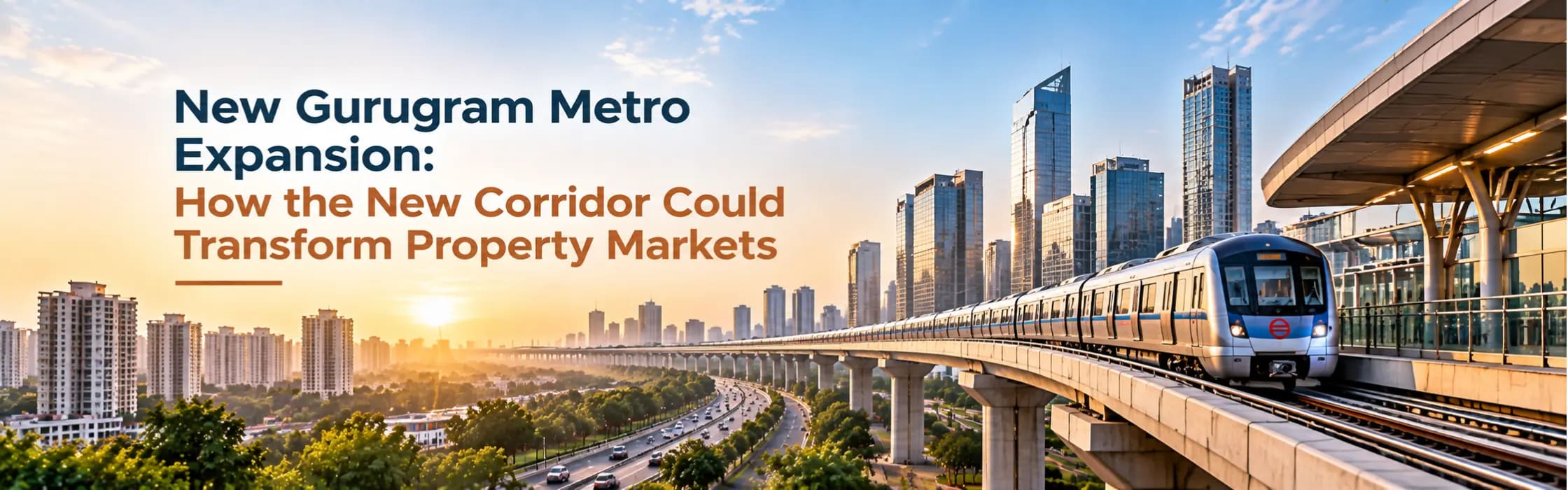
New Gurugram Metro Expansion: How the New Corridor Could Transform Property Markets
Gurugram has grown across two very different urban patterns: established neighbourhoods in Old Gurugram and newer residential, commercial and business districts across New Gurugram. The Gurugram Metro expansion is designed to connect these areas through a 28.5-km elevated network linking Millennium City Centre with Cyber City, along with a spur toward the Dwarka Expressway. Construction is already underway, making the project an important infrastructure development to watch for Gurugram real estate.
This blog looks at the planned route, current construction status, key timelines and what the available market evidence suggests about the potential impact of the Gurugram Metro expansion on property demand and values.
What Is the New Gurugram Metro Corridor?
The core of the expansion is a 28.5-km elevated corridor connecting Millennium City Centre to Cyber City, with 27 stations. The project is being implemented by Gurugram Metro Rail Limited (GMRL), a 50:50 joint venture of the Government of India and the Government of Haryana. Once complete, the corridor is planned to integrate Old and New Gurugram and provide interchange with the existing Delhi Metro Yellow Line and other transport systems.
The project was originally sanctioned at a cost of ₹5,452.72 crore. In 2026, the Haryana Government approved a revised project cost of ₹10,266.54 crore, along with supplementary reports and a proposal for World Bank financing. The funding structure has therefore evolved as the project has moved from planning into execution.
Gurgaon Metro Expansion: Route and Key Stops
The new line is routed through the parts of the city that public transport has historically underserved. It runs through:
1. Old Gurugram's residential core - Sectors 7, 4, 5, 3 and Ashok Vihar
2. Palam Vihar
3. Hero Honda Chowk and Subhash Chowk
4. Udyog Vihar
5. Cyber City
6. A dedicated spur connecting to the Dwarka Expressway
The corridor is significant because it is planned to connect established residential areas of Old Gurugram with major employment and commercial destinations including Udyog Vihar and Cyber City, while also extending toward the Dwarka Expressway. GMRL describes the project as an effort to integrate Old and New Gurugram across NH-48.
Project Timeline: Phase-wise Progress
| Phase | Route | Length | Status in 2026 |
|---|---|---|---|
| Phase 1 | Millennium City Centre → Sector 9 | ~15.2 km | Under construction; physical progress reported at around 12–13% in August 2026 |
| Phase 2 | Sector 9 → Cyber City | ~13.3 km | Moving through tendering, funding and preparatory stages |
| Dwarka Expressway spur | Basai Village → Sector 101 | 1.85 km | Part of the approved 28.5-km corridor |
As of August 2026, officials were targeting August 2028 for the start of operations on Phase 1, covering Millennium City Centre to Sector 9 and the associated Dwarka Expressway spur. Timelines for the wider corridor may differ because the remaining sections are at different stages of procurement and execution.
Gurgaon Metro: Funding and Financing Details
The World Bank approved a revised ₹1,409 crore loan proposal for the approximately 13-km Phase 2 corridor from Sector 9 to Cyber City in August 2026. The related civil tender covers works such as tracks and stations and was subsequently sent to the Haryana Government for approval. In May 2026, the Haryana Government also approved a supplementary report for the proposed metro connection between Sector 5 and Gurugram Railway Station, with the revised project cost including provision for this spur.
The Second Corridor: Sector 56 to Panchgaon (Manesar)
Running in parallel to the main Old to New Gurugram loop is a second, separate corridor that's easy to overlook but arguably just as significant for New Gurgaon and the southern industrial belt:
- Length: Approximately 35.25 km
- Stations: 28 planned stops
- Route: Sector 56 to Panchgaon, serving the Southern Peripheral Road (SPR) and the industrial town of Manesar
- Status: The revised Detailed Project Report (DPR) is being finalised following a September 2026 review by the Haryana government.
- The proposed corridor also passes through Global City, connecting the emerging mixed-use development zone with other residential, commercial and industrial areas along the route.
Ridership Projections
The project's original planning documents estimated daily ridership at approximately 5.34 lakh passengers in 2026, increasing to 7.26 lakh by 2031, 8.81 lakh by 2041 and 10.70 lakh by 2051. These are planning estimates rather than current passenger numbers, and actual ridership will depend on network integration, population growth, employment patterns and the eventual operational timeline.
Gurugram Metro's Impact on Property Values
| Location / Market | What Available Evidence Suggests |
|---|---|
| Old Gurugram | In 2023, industry experts cited by Moneycontrol estimated potential residential price appreciation of around 15–20% along parts of the proposed corridor. This was an expert estimate, not a guaranteed outcome. |
| Dwarka Expressway-linked areas | Infrastructure improvements and metro connectivity may influence buyer interest, but the effect will depend on station proximity, existing prices, supply and overall market conditions. |
| Metro-adjacent locations | Better public transport can improve accessibility and potentially support demand, but property performance varies by micro-market and project quality. |
| Rental market | Improved connectivity may support rental demand over time, but there is no verified basis here for stating a specific percentage increase. |
Why the Gurugram Metro Expansion Matters for Real Estate
The significance of the project is not simply its length. The planned corridor connects established residential areas in Old Gurugram with major employment and commercial locations such as Udyog Vihar and Cyber City, while the Dwarka Expressway spur adds another important growth corridor. GMRL itself describes the project as an effort to integrate Old and New Gurugram across NH-48.
For Gurgaon property, the key consideration is how improved connectivity between established residential areas and major employment hubs could influence accessibility, buyer interest and rental demand over time.
What Buyers and Investors Should Watch
-
Track construction milestones
Phase 1 is under construction, while Phase 2 is progressing through procurement and approval stages. Properties near Phase 1 stations are therefore at a different stage of infrastructure certainty than locations dependent on the later Phase 2 section.
-
Treat completion dates as a range
As of August 2026, officials were targeting August 2028 for Phase 1 operations. Buyers should nevertheless treat this as a project target rather than a guaranteed operational date.
-
Watch the Manesar corridor DPR approval
Since the revised DPR is still being finalised, the Sector 56–Panchgaon corridor remains at an earlier stage than the main corridor. Buyers should therefore distinguish between a proposed future connection and an approved, under-construction metro line.
-
Don't assume metro connectivity guarantees appreciation
Metro connectivity can support accessibility and demand, but property performance will vary by location, station proximity, supply, project quality, existing infrastructure and broader market conditions. Buyers should compare current prices with nearby projects rather than paying a premium solely because of a future metro connection.
Before shortlisting a project, buyers should also review the RERA checklist for homebuyers and verify the project's regulatory and documentation details.
Conclusion
The Gurugram Metro expansion is a major infrastructure project that could reshape connectivity between established residential areas in Old Gurugram and key employment and commercial districts such as Udyog Vihar and Cyber City. The Dwarka Expressway spur also adds another important connection to the city's expanding residential corridor.
For Gurgaon real estate, improved public transport can influence accessibility, rental demand and buyer interest over time. However, the impact is unlikely to be uniform across every sector. Station proximity, project quality, existing infrastructure, supply, pricing and the pace of construction will all matter.
Buyers and investors should therefore track actual construction progress and verify station locations rather than relying only on future infrastructure announcements.
Big Estate helps buyers and investors explore and compare properties by location, budget and property type, making it easier to shortlist projects in Gurugram's developing infrastructure corridors before carrying out their own property, RERA and financial due diligence.