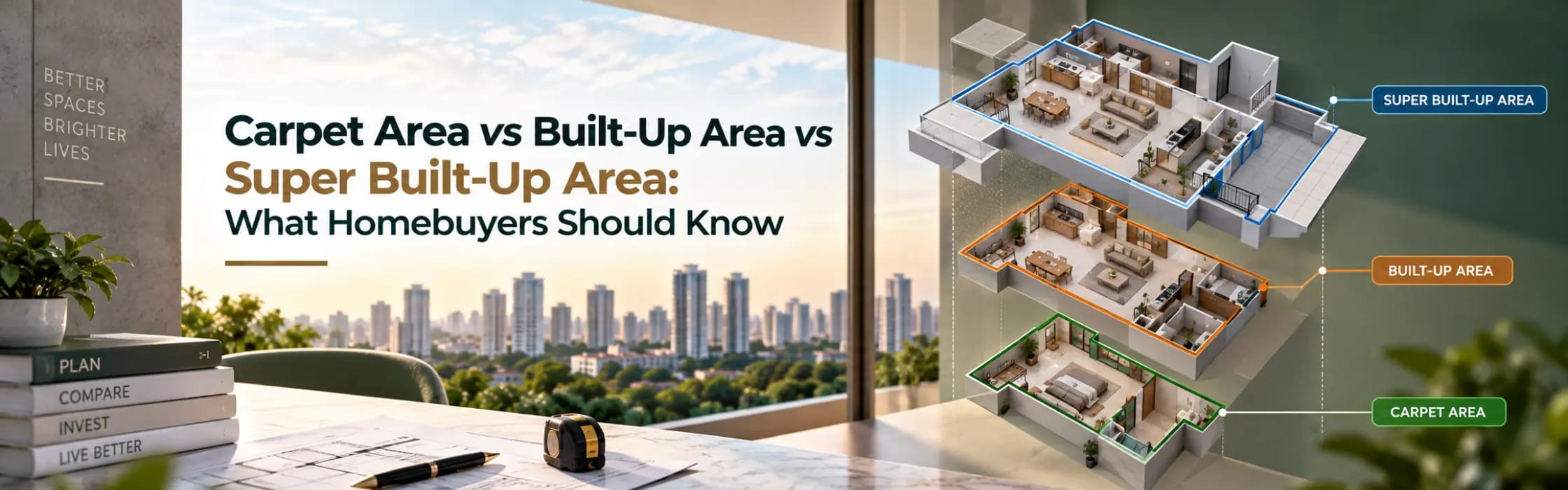
Carpet Area vs Built-Up Area vs Super Built-Up Area: What Homebuyers Should Know
You walk into a flat that's listed as 1,000 sq ft, and something feels off the moment you step in. It looks more like 700. You're not imagining it. This mix-up around carpet area vs built-up area is one of the most common sources of confusion for people comparing apartments, whether they are first-time buyers or repeat buyers.
Carpet Area vs Built-Up Area: Quick Answer
Here's the short version before we go deeper into carpet area vs built-up area:
| Term | What it means | How it relates to carpet area |
|---|---|---|
| Carpet area | Net usable floor area as defined under RERA | Base measurement |
| Built-up area | Carpet area plus applicable wall and other included areas | Varies by property |
| Super built-up area | Built-up area plus an allocated share of applicable common areas | Varies by project |
The table alone answers most of what people are really searching for. Now, let us deep dive into the details.
What Is Carpet Area
Under the Real Estate (Regulation and Development) Act, 2016 (RERA), carpet area means the net usable floor area of an apartment. It excludes the area covered by external walls, service shafts, exclusive balcony or verandah areas, and exclusive open terrace areas. However, the area covered by internal partition walls is included in the RERA carpet area.
In simple terms, carpet area is the floor area within the apartment that you can actually use, measured according to the RERA definition.
Example: If the RERA carpet area of a flat is 800 sq ft, that is the figure you should use when comparing the usable size of apartments across projects.
What Is Built-Up Area
Built-up area generally refers to the carpet area along with the area covered by walls and other components included in the property's stated measurement. The exact way built-up area is calculated can vary depending on the project, developer and applicable local measurement practices.
Unlike RERA carpet area, there is no single percentage that can be applied to every apartment to convert carpet area into built-up area.
For example, an apartment with an 800 sq ft RERA carpet area may have a higher built-up area after the applicable wall areas and other included components are considered. Buyers should check the project's actual area statement rather than relying on a standard percentage.
What Is Super Built-Up Area
Super built-up area is a commonly used industry term for a measurement that generally combines the built-up area of an apartment with the apartment's allocated share of certain common areas in a project.
Depending on the project and the way the area is presented, common areas may include elements such as lobbies, staircases, lifts and other shared facilities.
Because the calculation can vary between projects, buyers should not assume that a fixed percentage of carpet area will always produce the super built-up area. Instead, ask the developer for the detailed area statement showing the carpet area, built-up or saleable area and the basis used to calculate any common-area loading.
Understanding The Loading Factor
The loading factor describes the difference between the apartment's base area and the larger saleable or super built-up area used for pricing or marketing.
A simplified formula is:
Loading (%) = [(Saleable Area − Base Area) ÷ Base Area] × 100
However, there is no single loading percentage that applies to every residential project. The figure can vary based on the project's design, common areas, amenities and the way the developer defines and presents the saleable area.
Instead of judging a property only by its loading percentage, buyers should ask for a clear area statement and understand exactly which components are included in the quoted saleable or super built-up area.
Real Cost Difference Example
Say a builder quotes ₹8,000 per sq ft based on a 1,500 sq ft saleable area for a flat with 1,100 sq ft of carpet area. The quoted property price would be ₹1.2 crore. When that total price is divided by the 1,100 sq ft carpet area, the effective price works out to approximately ₹10,909 per sq ft of carpet area.
This illustrates why buyers should compare the total price against the carpet area rather than comparing only the advertised rate per square foot.
Why RERA Carpet Area Matters
RERA provides a standard definition of carpet area for registered real estate projects, helping buyers understand the actual apartment area on a consistent basis. The Act defines carpet area as net usable floor area while excluding external walls, service shafts, exclusive balconies or verandahs and exclusive open terraces, and including internal partition walls.
When evaluating a RERA-registered project, buyers should check the carpet area disclosed in the project's registration documents and compare it with the area stated in the builder's agreement and other sales documents.
The RERA registration details can also help buyers verify project information before making a purchase.
How to Compare Apartment Prices Using Area Measurement
The trick to comparing two flats fairly is picking one number and sticking to it, and that number should always be the carpet area, not built-up area or the saleable figure on the brochure.
Take the total price of the flat and divide it by the carpet area, rather than the number printed in bold on the price sheet. Do this for every project on your shortlist to calculate the effective price per sq ft of carpet area, giving you a more consistent basis for comparing the cost of usable apartment space.
Two flats can have similar advertised prices but very different effective prices per sq ft of carpet area if their area calculations differ. Comparing the total price against carpet area can reveal this difference more clearly.
Checklist Before You Buy
- Ask for RERA carpet area in writing, not just a verbal figure
- Compare price per sq ft across projects only on carpet area, never the saleable figure
- Ask directly what the loading factor is; don't let it stay hidden
- Match the figure in your sale agreement against the RERA portal listing
How Big Estate Helps You Compare Properties
Understanding carpet area, built-up area and saleable area can make it easier to compare properties beyond the headline square-foot figure. Big Estate helps buyers explore property options by location, budget and property type, making it easier to review project details while shortlisting homes.
When comparing properties, buyers should check the RERA carpet area and the applicable area statement alongside the total property price. This provides a more consistent basis for evaluating the space and cost of different apartments.
Also Read: How to Buy Your First Home in India (2026): Step-by-Step Guide