Real Estate CRM Features Every Real Estate Company Needs
Introduction
There are many CRM systems available in the market. It can be confusing for real estate agents. CRM systems enable organizations to track contacts, but these systems do not help skilled buyers understand basic real estate marketing concepts such as site visits, inventory retirement, and long-term tracking of real estate leads. Proper assessment of real estate CRMs also requires you to understand whether these systems can do lead tracking well. In this article, we will describe all real estate CRM functions necessary for real estate companies, explain their advantages, and provide recommendations on how to use this information.
What Are Real Estate CRM Features
Real estate CRM features are distinct items and functions that are included in CRM systems for controlling the real estate sales cycle. The system assists in lead collection, lead development, conducting visits, keeping track of property inventory, automating communication, and ensuring that the sales cycle is completed smoothly. While generic CRM systems may be used in any industry, the real estate CRM features are intentional to match the process of property transactions: making decisions, employing different devices and means of communication (WhatsApp, phone calls, site visits), and monitoring dozens of units or projects at a time.
For a CRM system to be acknowledged as a property management CRM, it needs to be more than just a contact management system that allows users to monitor leads only; it needs to be a connected platform that integrates various functions.
Why Is It Important
The functions of a real estate customer relationship management system are not merely a nice-to-have feature; it determines whether you can convert prospects into sales. Here are the reasons why:
- When negotiating a deal, the process in real estate can take a long time; a buyer can spend months and weeks deliberating on their decision, and if they lack access to the technology needed to manage leads properly, most agents are unaware of how close (or far) the prospect is to closing the deal.
- Leads tend to come from different places nowadays: Facebook, Google, real estate websites, WhatsApp, and walk-ins. That is why a CRM for a real estate company should consolidate leads, or else they’ll get spread all over the apps and simply vanish.
- Manual tracking does not scale well. As the team grows, spreadsheets and notebooks become incapable of handling large volumes of leads and tracking records because there are too many concurrent activities.
- Fast and continuous communication is what the buyers expect now. The right customer relationship management system will have features such as automatic reminders, drip campaigns, and instant messaging, enabling the business to stay on the customer’s mind.
How It Works
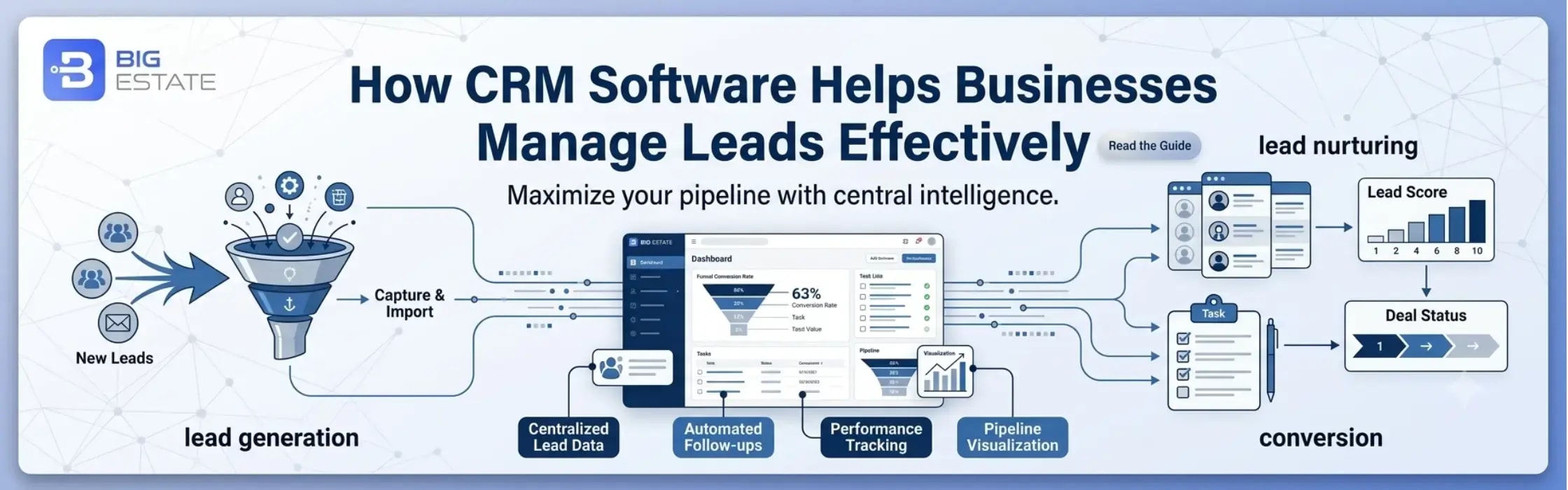
Stage 1: Centralized Lead Collection
The very first thing that a good real estate CRM does is to start collecting leads from different sources like Twitter campaign ads, websites, portals as well as WhatsApp and display them on a dashboard to eliminate manual data input and duplication.
Stage 2: Lead Management and Validation
Next is where the basic functionalities of real estate CRM come in: drip marketing and lead following activities, lead scoring, as well as follow-up reminders to keep in contact with all leads and not let any of them disappear.
Stage 3: Management of Properties and Pipeline
As soon as the leads get to the next stage, real estate CRM begins to track site visits, bookings and negotiations for particular objects, while property management functionality helps with keeping all information about inventory as well as documents in one system.
Benefits
Advantage 1: More Effective Lead Nurturing
Automated follow-ups, personalized texts, and activity-based triggers create consistent lead nurturing rather than relying on individual agents to follow up themselves, resulting in more leads remaining engaged.
Advantage 2: Organisational Benefits for Agents and Teams
Properly developed property managers use CRM, where they can continue all their communications, take notes, and create documents for their contact person, helping them to save time while selling properties.
Advantage 3: Complete Transparency with a CRM for Property Management
Real estate CRM not only enables businesses to communicate effectively with their clients but also allows them to see various activities regarding the management of the properties - not being limited to only lead conversion.
Challenges
- Feature overload: Some CRMs pack in so many real estate CRM features that teams get overwhelmed and only use a fraction of what they're paying for.
- Poor adoption: A CRM for real estate agents only works if agents actually log calls, updates, and follow-ups consistently; resistance to this habit is common.
- Weak lead nurturing setup: Many teams turn on a CRM but never configure proper nurturing sequences, so leads still go cold despite having the tool.
- Fragmented data: Without a true property management CRM approach, sales data, inventory data, and post-sales data can end up scattered across different tools.
- Cost vs. scale: Feature-rich plans can get expensive fast once you add more agents, projects, or channel partners.
Best Practices
- Prioritize lead nurturing workflows above all misleading features automated follow-ups and drip sequences provide the best ROI!
- Educate each real estate agent you hire on your chosen CRM software and not just the sales manager, as use diminishes when only management uses the software.
- Sort leads according to stage and intent so that your nurturing messages don’t seem generic and irrelevant.
- Utilize the property management CRM layer fully by overseeing both inventory details and post-sale achievements in one place and system.
- Make sure to review your drip sequences quarterly so that the content of the messages complies with the latest updates.
- Allow your CRM to remain the single source of truth for all the CRM features you use.
Comparison: Must-Have vs. Nice-to-Have CRM Features
| Feature Category | Must-Have | Nice-to-Have |
|---|---|---|
| Lead Management | Automated lead capture from all sources, duplicate detection | Predictive lead scoring |
| Lead Nurturing | Drip campaigns, automated follow-up reminders, WhatsApp/SMS/email sequencing | AI-personalised messaging |
| Property Management CRM Layer | Inventory tracking, site visit scheduling, document management | Construction milestone tracking |
| Communication | Call logging, click-to-call, WhatsApp integration | Built-in dialer with recording |
| Reporting | Pipeline visibility, source-wise lead reports | Custom BI dashboards |
| Mobile Access | Mobile app for field agents and site visit updates | Offline mode |
Use Cases
- A solo real estate agent based in Delhi NCR makes use of a lightweight CRM to perform automation of follow-up communications.
- A fast-growing real estate brokerage company in Bengaluru applies some lead nurturing techniques in order to keep numerous leads warm for several weeks.
- A construction company managing high-rise buildings in Gurugram is successfully using advanced tools of property management instead of facing issues of double-booking.
- A regional sales department is making use of CRM reports for optimization of marketing strategies in terms of the placing of time, budget, and many other aspects.
Key Takeaways
- The features offered by CRM in real estate transcend the simple storing of contacts it is all about nurturing leads, automating communications, and tracking properties that help close deals.
- The real estate CRM helps only if the entire team makes constant use of it and not just the top officials.
- Nurturing leads is the category of features with the highest potential since property transactions encompass lengthy decision processes.
- The right real estate CRM should combine lead tracking capabilities before the sale and inventory management after it under one roof.
- There is no need to implement all features from the very beginning — at first, it is necessary to prioritize lead generation and nurturing and only then move to more sophisticated functions.
Conclusion
Selecting a Customer Relationship Management (CRM) system is not just about selecting the one that has the biggest attributes list but looking for a CRM for real estate agents that does away with the problems you are currently facing, whether it is slow lead processing, disorganised inventory, or lack of transparency in the sales process. A perfect CRM for estate agents combines isolated leads and spreadsheets into a unified and traceable system that provides aid in all dealings with clients from the first inquiry to the final transfer of the property.
If you are interested in establishing a sales process backed by a CRM system that will handle the leads and not lose them, get in touch with the experts at Big Estate to learn how you can link relevant features of your CRM with your real estate advertising campaign.