Top 5 Real Estate CRM Tools to Manage Property Leads
Introduction
The core reason that causes every real estate company, from the one-person broker in Gurugram to the real estate developer managing ten projects across Bengaluru and the NCR, to lose leads is that not every lead is attended to immediately enough. Therefore, if a lead fills out a form on your landing page, but you do not call him or her back for six hours, he or she has possibly talked to three other competitors already. In an environment where quick follow-ups determine who earns the deal, it is clear that using a classic approach based on Excel files, sticky notes, and WhatsApp messages is inefficient.
This is where property management CRM systems come in. A good property CRM system not only collects contacts, but also collects leads as they come in, assesses them, passes them to sales executives, and keeps track of follow-ups until the site visit or reservation takes place. In this article, we present information about CRM systems for real estate and how they operate, what benefits they can bring, and what five tools can be used for automating sales in real estate.
What Is a Real Estate CRM
A real estate CRM (Customer Relationship Management) tool refers to software developed explicitly to monitor the complete lifecycle of a property lead, from the first inquiry made through an advertisement to the final post-sale follow-up. This type of software differs from a generic CRM that can be utilized in any industry; a builder CRM is tailored specifically to the smooth running of property deals which involve numerous sources of leads (Meta, Google, 99acres, Housing.com, MagicBricks, WhatsApp), prolonged negotiation periods, scheduling and keeping track of site visits, blocking inventory to avoid double-sales in real-time, and completing post-booking tasks such as demand letters, and collecting payments of installments.
In a nutshell, a real estate CRM brings together every conversation, all lead sources and all stages of the sales funnel onto a single interface, preventing the need for one’s memory or WhatsApp thread to be relied on.
Why Is It Important
For a real estate business, a CRM isn't a "nice to have" — it directly affects revenue. Here's why:
- The leakage of leads costs a lot of money. Missing a single follow-up with a prospective customer for a high-priced deal may cost one several lakhs and sometimes crores.
- Capturing leads from multifarious sources and consolidating them into one system is essential. While advertisements from Meta, Google, and real estate marketplaces can lead to enquiries, the sales team may have to spend time copying data across spreadsheets in the absence of a dedicated CRM.
- Timely response to inquiries is important. These days, a customer usually reaches out to 3 or 4 builders or agents at a time. Being the first to respond and follow up frequently gives one an edge over the competition.
- Sales teams need to have access to the details regarding the number of leads in the funnel at any moment in time, who is working on any particular lead and where the deal is stalled.
- CRM helps in maintaining relationships with customers after the sale as well.
How It Works
Step 1: Lead Capture
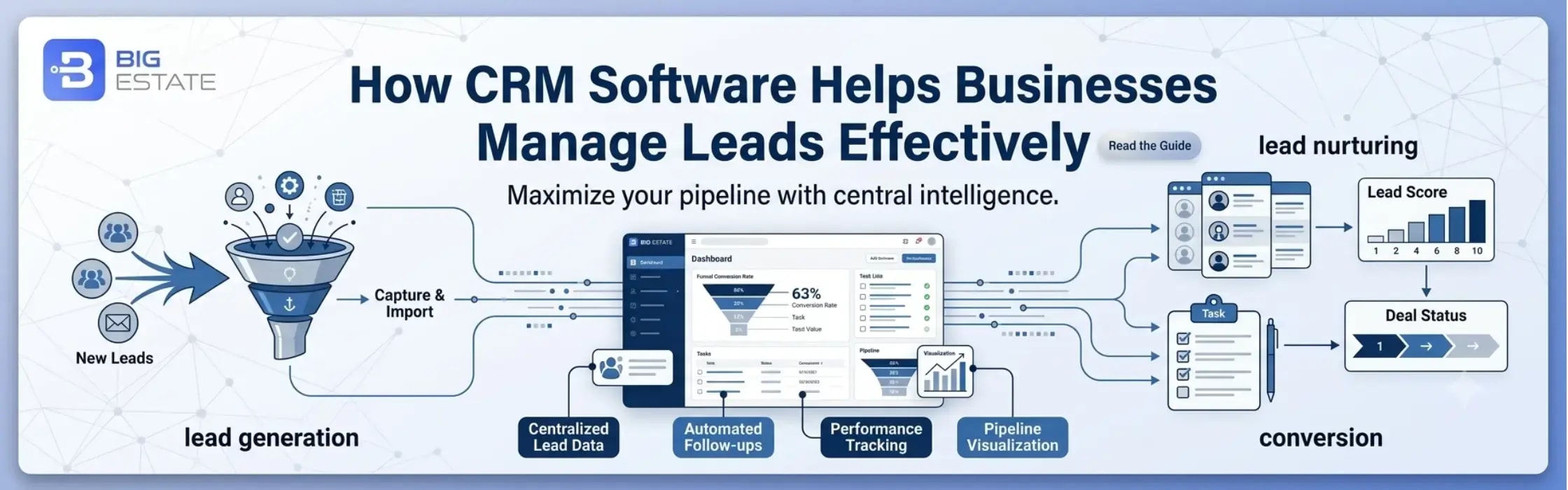
The system captures leads automatically without the manual intervention of entering them. The leads can be from various sources like Facebook ad forms, Google ad forms, website forms, property portals, walk-ins, and WhatsApp messages. The duplicate leads are merged, and the source of each lead is tagged.
Step 2: Lead Qualification and Routing
When the lead comes to the CRM, it gets automatically scored on various criteria, including the budget, the engagement level, the preference for BHK, area of interest, etc. The scoring is done, after which the right sales channel or the sales executive is assigned to the lead on various bases, including the region of operation and availability.
Step 3: Marketing, Site Visits and Closure
From this point onwards, the CRM follows up with the lead on all platforms: WhatsApp, SMS and email. The CRM tracks the complete journey of the lead till the final purchase of the property and also after that till post-sale activities like token payments are done.
Benefits
Advantage 1: Complete Control of Leads
Every inquiry, regardless of the source, is recorded immediately so no potential customer is neglected or misplaced.
Advantage 2: Quicker Response Equals More Sales
With rapid replies and automated lead allocations, prospects can expect a response in a matter of minutes, rather than hours, in turn, significantly increasing the chances of converting a lead into a visit.
Advantage 3: Total Transparency in Sales
Up-to-the-minute dashboards provide heads of sales departments and marketers with an idea of the sales funnel condition, which allows making well-informed decisions rather than relying on guesswork.
Challenges
Although the most excellent CRM comes with its share of practical issues that need to be taken into account, they include the following:
- Resistance to adoption: sales teams accustomed to informal means of communication such as WhatsApp, as well as their personal laptops, usually shy away from keeping all the data in the CRM system.
- Implementation time and customization: formal workflows specific to the real estate industry (such as property listing, property visits, approval requests, etc.) require a lot of tweaking before the CRM system is used properly.
- Integration problems: as generic CRMs do not connect with various real estate platforms or WhatsApp Business services, extra software programs such as Zapier are used to integrate them into the system.
Best Practices
- Before implementation, get the support of leadership as sales departments utilize tools faster with management’s guidance.
- Make sure the first response to every lead is automated so they can receive acknowledgment in WhatsApp or SMS instantly before receiving a call from a human or an agent.
- Ensure there are binding service level agreements (for instance, return call after 5 minutes of lead capture) and track compliance in the CRM system.
- Utilize lead scoring to make it easier for sales representatives to detect the genuine buyers from the casual ones.
- Insist on weekly meetings with the sales department to analyze the data gotten from the sales funnel so that any move is easy to track — from bottlenecks where the lead is stuck, to low conversion rates and slow response.
- Ensure that the CRM remains the source of reliable information so no discussions take place via WhatsApp numbers that are not included in the system.
Comparison: Top 5 Real Estate CRM Tools
| CRM Tool | Best For | Standout Feature | Note |
|---|---|---|---|
| Big Estate | Builders and brokers across Bengaluru, Gurugram, and the NCR wanting an all-in-one, India-first CRM | AI-powered calling for instant lead response, WhatsApp-native follow-ups, and end-to-end tracking from enquiry to site visit to booking | Built specifically for how Indian real estate teams sell — no lengthy customisation needed to go live |
| Sell.Do | Builders and brokers wanting an India-first, real estate-only CRM | Native WhatsApp Business integration, AI-powered lead scoring, inventory and channel partner management | Widely used by developers and brokerages across India; quick 7-day setup |
| LeadSquared | Developers running high-volume paid marketing campaigns | Strong lead qualification and distribution engine, marketing automation, near-zero lead leakage | Popular with large builders for high lead volumes from Meta/Google ads |
| Zoho CRM | Teams wanting flexibility and affordability | Highly customisable modules, 1,000+ integrations, WhatsApp via third-party connectors | Not real-estate specific out of the box, needs configuration for property workflows |
| Paramantra | Builders and brokers wanting an India-focused, real estate-only tool | Built-in call management, strong post-sales visibility | Real estate-specific modules, though interface feels less modern |
Every CRM has its strengths depending on your business size and sales process. For a detailed breakdown of features, pricing, and performance, check out our complete guide: Best Real Estate CRM Software in 2026: Top 5 Compared
Use Cases
- Meta and Google ads are being run by a property builder in Gurugram over various projects, using LeadSquared or Sell.Do as the CRM for connecting leads based on the project and analyzing the effective campaign that is generating maximum visits on the website.
- A real estate company in Bengaluru, which is gathering leads through several websites including 99acres, Housing.com, and MagicBricks, uses a CRM to accumulate all leads from different sources in a single dashboard.
- A medium-sized builder in NCR builds houses and uses builders’ CRMs, like DaeBuild or Paramantra, to track leads and also milestones after a booking is done, such as demand letter, payment schedule, and possession information.
- A team from the commercial property world uses a powerful CRM such as Zoho, allowing them to create a pipeline in accordance with the long B2B sales cycle where different decision-makers must be involved.
Key Takeaways
- In one system, a real estate CRM consolidates the processes of lead gathering, qualification, follow-up, and after-sale analysis and monitoring.
- The swiftness of response and standardisation of follow-up can be the main difference between signing a contract and losing a potential client.
- India-specific CRMs (Big Estate, Sell.Do, LeadSquared, Paramantra, DaeBuild) have WhatsApp integration and real estate workflows, which are not equipped in ordinary systems.
- The “best” CRM will vary depending on one’s position — whether he/she is a stand-alone broker, a growing real estate agency or a big developer with construction and inventory demands.
- A CRM can generate revenue only if it is used efficiently with set follow-up guidelines from one’s sales department.
Why Choose Big Estate
The gap that is not discussed by many builders and brokers is that no one consolidates all ad campaigns and customer relationship management tools into one solution. Without such integration, leads become lost, delayed or duplicated. No matter how good the CRM tool is, if the leads sent to it do not work properly, then the CRM is unable to solve the issue completely.
In this context, Big Estate is incredibly effective, as it allows for running and controlling all the ad campaigns, such as those used in Meta, Google searches, as well as Demand generation mechanisms.
How the integration actually works:
- Capture leads instantly to source – Any submission made using a Meta lead form, Google Search ad, or Demand Gen campaign is captured instantly along with details of such sources as the ad, campaign and creative.
- Direct leads to your CRM – There is no requirement for export/import cycles. Leads are automatically sent to your CRM whether you are using Sell.Do, LeadSquared, Zoho, Paramantra or DaeBuild.
- Find out whether your marketing spend is justified by bookings – As leads go through the stages of the CRM, like site visit scheduled, qualified, and booked, this data reflects back in your analytics.
What this means for your sales and marketing teams:
- Zero delay between advertisement and inbox: There is no need for leads to remain in the advertisement dashboard while the sales team is operating with an outdated CRM.
- Campaign-based ROI as opposed to being lead-based: You can obtain the necessary information about the ads and whether they generate revenue.
- No duplicates: There is a removal of duplicates from leads coming in from different channels for the same prospect.
- Sales process starts with context: Prospects come with the advertisement and the offer they have responded to.
This is what sets the builders undertaking multi-project campaigns in Bengaluru, Gurugram, and NCR apart: the CRM gives the necessary inputs in the pipeline for generating leads, while Big Estate ensures that there is no dearth of good-quality, real-time leads in the pipeline.
Conclusion
Selecting the best real estate CRM tool isn't about selecting the one with the greatest number of features. It is about choosing the tool that fits the way your sales team operates. Whether that is a lone broker managing leads via WhatsApp or a developer dealing with stock across various projects in Gurugram, NCR, or Bengaluru, the common point for all businesses today is an immediate response, effective follow-up, and full visibility into the business process.
Would you like to stop losing leads because of slow responses? Get in touch with Big Estate’s team to connect your advertising campaigns to your CRM and filter your sales process according to the way your projects sell.